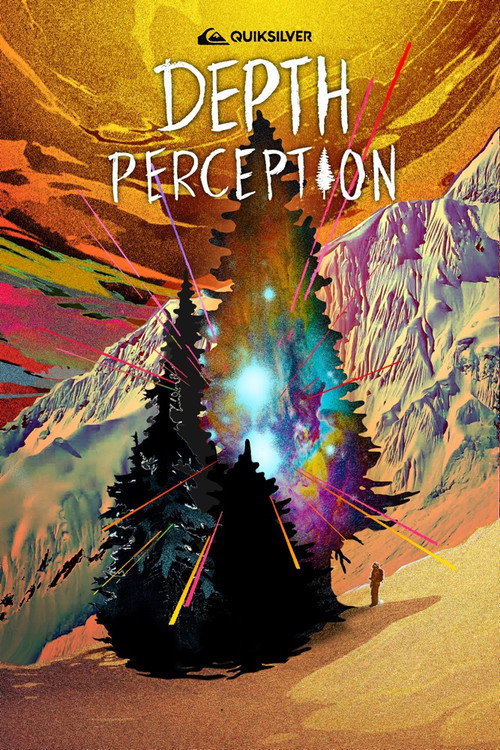
Depth Perception
"Travis Rice's latest production draws an unexpected vision on backcountry snowboarding."
⭐ 7.02017-10-1661 minReleased
Revenue
Not Disclosed
Budget
Not Disclosed
Where to Watch
Stream in high quality


Global Revenue
Not Disclosed
Detailed Plot
Depth perception is the ability to perceive distance to objects in the world using the visual system and visual perception. It is a major factor in perceiving the world in three dimensions
Depth sensation is the corresponding term for non-human animals, since although it is known that they can sense the distance of an object, it is not known whether they perceive it in the same way that humans do.
Depth perception arises from a variety of depth cues. These are typically classified into binocular cues and monocular cues. Binocular cues are based on the receipt of sensory information in three dimensions by both eyes while monocular cues can be observed with just one eye. Binocular cues include retinal disparity, which exploits parallax and vergence. Stereopsis is made possible with binocular vision. Monocular cues include relative size (distant objects subtend smaller visual angles than near objects), texture gradient, occlusion, linear perspective, contrast differences, and motion parallax.
Depth cues fall into two categories: Pictorial cues and nonpictorial cues. Pictorial cues are depth cues that can be shown using a two-dimensional picture, and nonpictorial depth cues require more than a two-dimensional picture to show. Pictorial cues require conscious human cognition paired with medium-level visuospatial system processing functions concentrated within the neocortex to discern. Nonpictorial cues are those such as monocular accommodation, which require lower functions of the visual system focusing on pre-neocortex optical responses.


Production Stills & Gallery

View HD